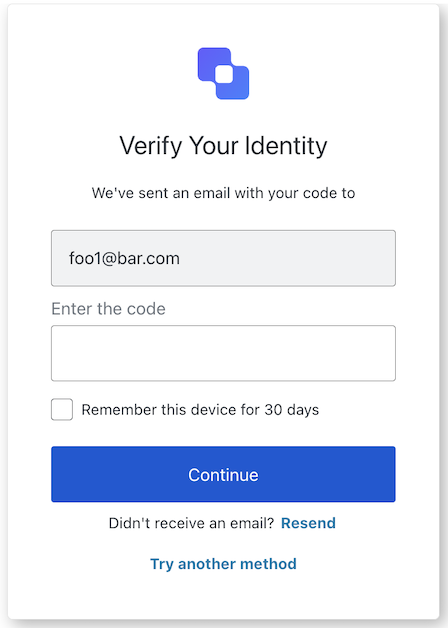
The MfaEmailChallenge class implements the mfa-email-challenge screen functionality. This screen is shown when a user needs to verify their email during MFA.
Constructors Create an instance of MfaCountryCodes screen
import MfaEmailChallenge from '@auth0/auth0-acul-js/mfa-email-challenge' ; const mfaEmailChallenge = new MfaEmailChallenge (); await mfaEmailChallenge . continue ({ code: '123456' , rememberDevice: true });
Properties Provides branding-related configurations, such as branding theme and settings.
Provides client-related configurations, such as id, name, and logoUrl.
Provides information about the user’s organization, such as organization id and name.
Contains data about the current prompt in the authentication flow.
Contains details specific to the mfa-email-challenge screen, including its configuration and context.
Contains data related to the tenant, such as id and associated metadata.
Provides transaction-specific data, such as active identifiers and flow states.
Handles untrusted data passed to the SDK, such as user input during login.
Details of the active user, including username, email, and roles.
Methods This method continues with the email challenge using the provided code. import MfaEmailChallenge from '@auth0/auth0-acul-js/mfa-email-challenge' ; const mfaEmailChallenge = new MfaEmailChallenge (); await mfaEmailChallenge . continue ({ code: '123456' , rememberDevice: true });
The options for continuing with the email challenge. The code entered by the user.
Indicates whether to remember the device.
[`key`: `string`]
"string" | "number" | "boolean" | "undefined"
Additional data collected from the user.
This method retrieves the array of transaction errors from the context, or an empty array if none exist.
This method submits the action to pick a different Email configuration, if available. import MfaEmailChallenge from '@auth0/auth0-acul-js/mfa-email-challenge' ; const mfaEmailChallenge = new MfaEmailChallenge (); await mfaEmailChallenge . pickEmail ();
Optional payload. [`key`: `string`]
"string" | "number" | "boolean" | "undefined"
Additional data collected from the user.
This method resends the email code. import MfaEmailChallenge from '@auth0/auth0-acul-js/mfa-email-challenge' ; const mfaEmailChallenge = new MfaEmailChallenge (); await mfaEmailChallenge . resendCode ();
Optional custom options to include with the request [`key`: `string`]
"string" | "number" | "boolean" | "undefined"
Additional data collected from the user.
This method resends functionality with timeout management for this screen. A ResendControl object with startResend method. import MfaEmailChallenge from '@auth0/auth0-acul-js/mfa-email-challenge' ; const mfaEmailChallenge = new MfaEmailChallenge (); const { startResend } = mfaEmailChallenge . resendManager ({ timeoutSeconds: 15 , onStatusChange : ( remainingSeconds , isDisabled ) => { console . log ( `Resend available in ${ remainingSeconds } s, disabled: ${ isDisabled } ` ); }, onTimeout : () => { console . log ( 'Resend is now available' ); } }); // Call startResend when user clicks resend button startResend ();
Optional custom options to include with the request. This method allows the user to try another MFA method. import MfaEmailChallenge from '@auth0/auth0-acul-js/mfa-email-challenge' ; const mfaEmailChallenge = new MfaEmailChallenge (); await mfaEmailChallenge . tryAnotherMethod ();
Optional custom options to include with the request. [`key`: `string`]
"string" | "number" | "boolean" | "undefined"
Any additional custom options.